
Warning: Underground Blockages
Amazon's Stochastic Parrots do Lit-Crit

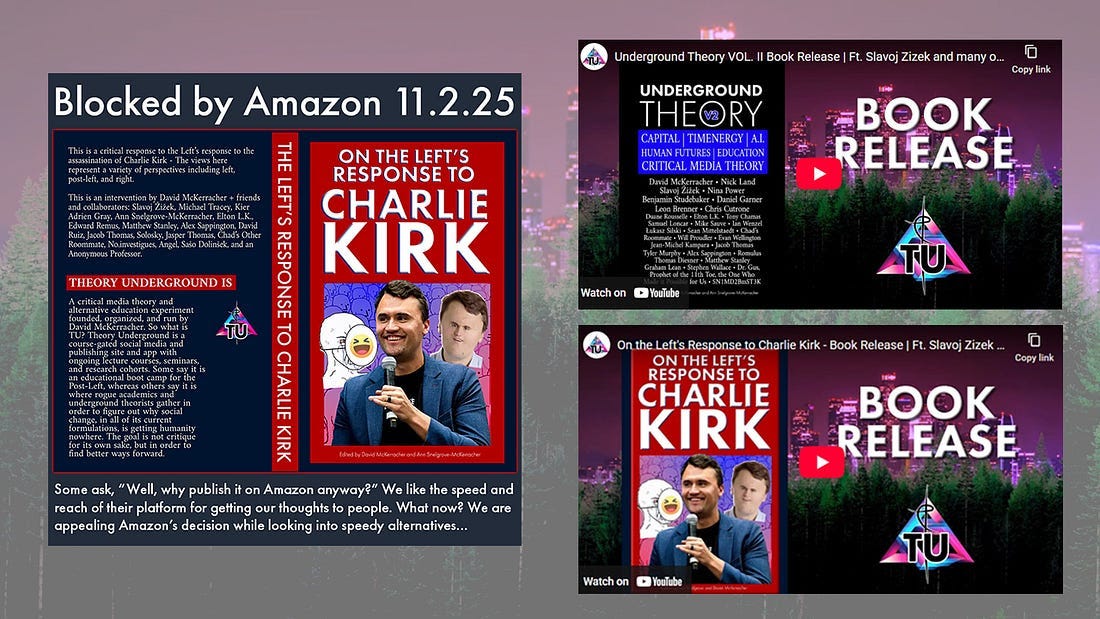
When I first saw Theory Underground’s flyer announcing their new anthology, On the Left’s Response to Charlie Kirk: An Intellectual Reflection on Kirk’s Assassination, my first thought was that it could be a best-seller: a timely text with a cover featuring a not unflattering picture of Kirk, and contributions by ‘big names’ such as Slavoj Žižek and Michael Tracey. Unfortunately, the book has been ‘blocked’ by AmazonKDP.
Theory Underground, like my own enterprise BPC Publishing, and many others in the field, operate independently of academia and the ‘legacy’ media. David McKerracher of TU says of his engagement with the world of small-press/self-publishing:
‘I think that the world that we want to live in has something as sophisticated as KDP. That kind of direct-publishing is absolutely—I mean it’s everything to me, man. I think it’s so important—I think it’s just absolutely amazing that we’re able to do this work.’
Interestingly, his ‘engagement’ with Amazon runs deep:
‘When I wrote Time Energy… I was working at Amazon... at BOI2 in Boise, the second warehouse... That was something that I felt like it made sense, you know, because Amazon is the literal future of work — for better and for worse. I was thinking about why we don’t have any time or energy, the subtitle of my book, Time Energy. I was thinking about automation and I was watching the actual future of automation and the way that it’s not actually freeing people up from labor but is instead keeping people busier than ever. I was theorizing that on the ground while writing that book and I wanted to publish it at Amazon.’
But why Amazon?
‘People were like, “Well, why are you publishing at Amazon?” It’s got the reach, baby. It’s got the reach. It can get books to more people faster than anywhere else. And when you go looking for something, you go there. Most people go there. If you’re boycotting it because you’re so pure, well then great for you. You know, I believe in standing on your ideals and picking your battles. Me, in picking my battles wisely.’
AmazonKDP, the largest direct publishing self-publishing platform in the world, isn’t actually a publisher, in that it doesn’t do the things that publishing companies do. If you, as an author/self-publisher, sign up with a ‘legacy’ publisher, it takes care of the copy-editing, proof-reading, typography, cover-design, checking for legal issues -such as libel – promotion, etc. If you sign up to KDP, on the other hand, you are responsible for doing all those things yourself. And if you have subversive thoughts that you plan to air in a book the question is, if you are outside the ‘legacy’ then who is going to police your writings if not the the stochastic parrots of AI and their human rubber stampers at KDP?
Censorship is associated either with state-power (which Amazon doesn’t have in the direct sense - yet) or with something just as effective (which, arguably, is what is coming courtesy, of the tech god monopolies, AI, crypto and Trump/ Vances spellbinder coalition of ‘libertarians’, religious bigots and outright fascists).
McKerracher says that the aim of the anthology about the murder of Charlie Kirk is to
‘force the issue and actually have a deeper conversation about something that has been so sensational, polarizing, divisive... we brought together people from across the political spectrum who wanted to go deeper, who are against violence and who are against censorship and who want to think deeply about this whole issue.’
After TU submitted the finished book for publication, AmazonKDP, in their own words, ‘blocked’ it: all of it - cover content, proposed ads, and even TU’s access to the book’s KDP files:
‘Based on our review, we won’t be accepting your submission for publication because the book[s] might result in a disappointing customer experience.’
Obviously, any book ever published ‘might’ have been disappointing for some readers (how else could there ever be such a thing as literary criticism). But since TU’s anthology has been blocked, there are no customers to consult.
As this reasoning formed much of TU’s appeal submission, Amazon came up with ‘facts’ determined as follows:
‘During a quality assurance review of you catalog, we found that your book[s] are resulting in a disappointing customer experience.’
In other words ‘we’ (or the AI) don’t like you, and we can boot you anytime we want. But the question here is how this assessment was made. In what ways were the customers disappointed. Were their opinions expressed in the ‘reader reviews’ or star-ratings on the TU Amazon page. Did they expose obscenities and hate-speech in TU’s previous titles. Was anyone (I’d hate to ask) ‘triggered’ by the reading experience - if so, how?
Whatever reasoning is done by Amazon, they keep it to themselves, for the same reason they avoid paying taxes. Because they can.
How indeed? How now brown cow?