
The Expressionist and the Nazis
GW Pabst in Daniel Kehlmann’s novel, The Director

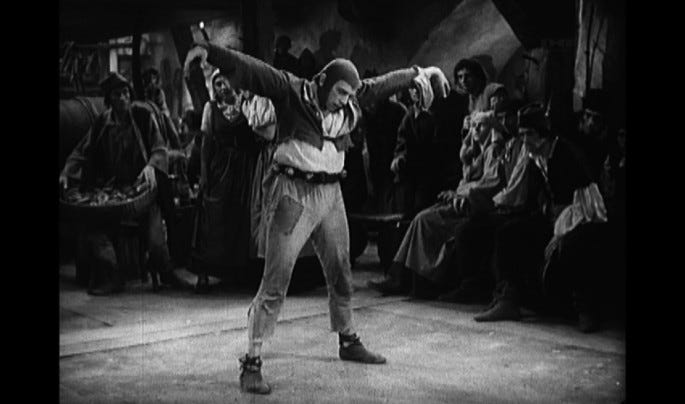
In 1923, Georg Wilhelm Pabst (1885-1967) directed the movie,The Treasure, which immediately established him as a leading light in the Austro-German Expressionist film genre, along with Fritz Lang (Dr Mabuse), FW Murnau (Nosferatu) and Robert Wiene (Dr. Caligari). By the time sound arrived Pabst had made ten movies, 'discovering', along the way, Greta Garbo (Silent Street), Louise Brooks (Pandora's Box) and (more curse than blessing) Leni Riefenstahl (who directed the Nazi documentary Triumph of the Will).
With the arrival of talkies Pabst began to mix his expressionism with social-realism. His trilogy of Westfront 1918 (1930), an 'anti-war' movie; The Threepenny Opera (1931), based on the Bertholt Brecht musical; and Kameradschaft (1931), about solidarity between German and French coal-miners, earned him the nickname 'Red Pabst'.
When the Nazis seized power and took over the German film industry, its cream of talent, including Lang, Murnau and Wiene, fled into exile. Pabst decided to try his hand in Hollywood.
As described, fictionally, in Daniel Kehlmann’s page-turning novel, The Director, it doesn't go well. The studio bosses insist that he direct a no-hoper, entitled A Modern Hero (1934), which duly bombs, all but destroying his marketability in Tinsel Town. Disillusioned, Pabst next tries France and makes a pedestrian spy movie, Street of Shadows (1937).
At the outbreak of war in 1939, Pabst finds himself stuck with his family in the Third Reich. His presence is noticed by propaganda minister Joseph Goebbels, who calls him in, and reminds him that he was (or is) 'Red Pabst'.
'But you are sorry?'
'Pardon me?'
'You have engaged in communist propaganda, you were an enemy of the German people, you have made common cause with other enemies of the people, and with Jews. Actually. All that is unforgivable...
To gain a little time, Pabst leaned forward...
'I was never a communist. With all due respect. I have also not engaged in -'
'You misjudge the situation. I'm not arguing. If you had just the slightest idea of what could be in store for you, you wouldn't even try. It is what it is, and I say what it is, and all you say here is: I'm sorry. And you say: now I know better! And: I have recognised my mistakes. And I want to do my part in building a new Germany. Well?'
Pabst capitulates. Goebbels immediately gives him a screenplay to direct: Komödianten, a historical drama.
'Caraline Neuber , Pabst! The inventor of German theatre. Pabst! Lessing's patroness, Pabst! The script is by two Weltbühne writers, left-wing riff-raff, people like you who should be in a concentration camp, but who have recognised the truth and seen the light. Entirely apolitical material, Pabst. So it shall remain too. It is mean to be idealistic. Metaphysical. Noble'.
But the Nazis’ 'historical' dramas are political, the heroes of the past are celebrated as nationalist precursors of Hitlerism and the Fuhrer-Prinzip.
In 1943, Pabst makes Paracelsus. Set in Basel in 1527, Paracelsus, the official physician of the city, provokes the ire and jealousy of the Scholastic medical establishment, who want rid of him. In the Nazi hagiographies published in 1941 for his 400th anniversary, Paracelsus is portrayed as a pioneer in Blood-and Soil' German science. Nietzsche saw him as anticipating Goethe. The philosopher Alexandre Koyré asked:
'Who was he, this brilliant vagabond? A profound scholar who, in his battle against Aristotelian physics and classical medicine, laid the foundations of modern experimental medicine? A precursor of nineteenth-century rational science? An inspired, erudite physician, or an uneducated charlatan, vendor of superstitious quack medicine, astrologer, magician, inventor of gold, etc.? One of the greatest intellects of the Renaissance, or an old-fashioned heir to the mysticism of the Middle Ages, a ‘Goth’? A pantheistic cabalist, follower of a vague stoical Neoplatonism and natural magic? Or, on the contrary, is he ‘the healer,’ that is to say, the man who by concerning himself with suffering mankind discovered and formulated a new conception of life, of the universe, of man, and of God?’
Such were the questions, but as far as the Nazis were concerned, Paracelsus, as Eric Rentschler says in The Films of G.W. Pabst : an extraterritorial cinema,
'fully embodies the “Fuhrerprinzip.” He joins a noble line of self-effacing heroes, who, from Frederick II to Bismarck, devoted themselves to the glory of the German people while sacrificing their private life... Paracelsus also experiences the ingratitude and misunderstanding of his contemporaries... in the scholar’s desire to use German rather than Latin, both in his scientific and philosophical writings as well as in his teaching.'
Kehlmann pulls a master stroke in having PG Wodehouse attend the premier of Paracelsus in Salzburg in 1943. The real-life Wodehouse was interned as a POW when he found himself in Germany when war broke out. The Nazis allowed him to stay, at his own expense, in a posh Berlin hotel, with the extra price of having to record some talks for Berlin radio. When re-broadcast to Britain, in between Lord Haw Haw's rants, he was labelled as a a traitor – even though his talks weren't political.
For the Paracelsus premier, Wodehouse is provided with evening dress and is accompanied by his propaganda ministry handler, who reminds him of his POW status, and directs him for a celebrity photo-shoot:
'In front of the cameras please'. I bridled. There had been no suggestion of cameras. 'It's not a suggestion.'
Wodehouse meets Pabst, who is friendly, but can hardly speak English. Pabst's wife, Trude, does speak English and she knows Pabst is heading for trouble. She invites Woodhouse to arrange for an escape of all three of them to Switzerland.
Wodehouse meets Guido Merwetz:
'Once a feared critic. Now one of our subtlest describers.. describes beginning, middle and end.. what the actors look like.. He's not allowed to write that an actor is good, for that would be criticism too.. and imply that that an actor could be bad. But how would that be possible? The films are produced by the ministry, so how could they be anything but excellent?'
Wodehouse meets Leni Riefenstahl, who hates Pabst and is comically humourless. 'She had evil eyes and bared frightfully white teeth. Her skin seemed to be cast from Bakelite'. He meets the Nazi Anglophobe Alfred Karrasch, whose novel is being adopted for Pabst's next film.
When it comes to Paracelsus the movie Wodehouse is spellbound. When Paracelsus quarantines the city against the plague, the acrobat Fliegenbein, known for his 'winged feet', steals into the city and performs in a tavern.
'The people in the tavern were engrossed in the dance. They tapped their feet, nodded their heads and shrugged along to the music... the first few stood up and mimicked his steps – but then more and more of them joined in, and then none could resist, no one could sit, everyone in the rook was dancing. There was nothing joyful about it, neither mirth nor freedom forward and back and to the left and to the right, they jumped, their bodies twitching and writhing, seemingly unleashed, yet in perfect unison and with desperate faces. No one deviated in the slightest. Paracelsus, entered, a large sword in his hand. He watched them dance with a diagnostic eye, then he gave a nighty shout. All at once the dance came to an end.'
Some see allusion in this to Nazi madness. Paracelsus's temporary victory over Death is tempered by a 'death march’ of flagellants into the city, which may or may not have reflected the doom of Nazi hopes after Stalingrad. A peasant rebel song heralds the arrival of the dying Von Hutten who, being a real noble rebel, seems quite un-Hitlerish.
Kehlmann's PG Wodehouse is then no more historically inaccurate than Pabst's Paracelsus, which was, after all produced by Goebbels. Pabst did try to atone for his wartime career by going on to make The Last Ten Days, which showed the evil and depravity, of Hitler, Goebbels and co in the bunker.
In sum Kehlmann’s The Director, is meditation on the art of complicity and complicity in art.
Good Article!