
Doing the Dérive in Brooklyn
Art Beyond the Gallery

David Gitt, Brooklyn art graduate and retired New York firefighter, drew my attention to a promising ‘post-situationist’ project that he and other artists are organising. The following text comes courtesy of their website EVERYTHING IS FREE NOW. EIFN organises a dérive every couple of weeks. Check the site for upcoming (post-freeze) events.
PART ONE
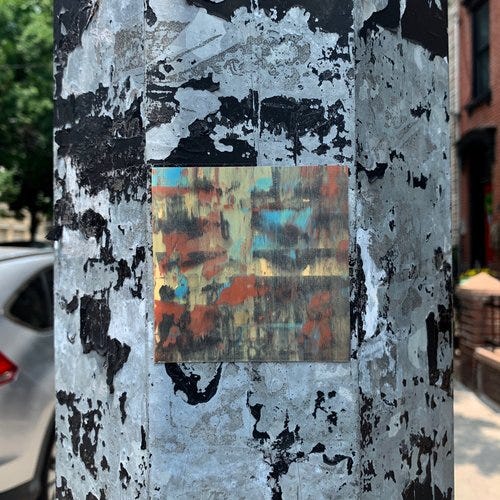
This work is part of an ongoing collaborative project involving several artists who make paintings for display in outdoor public spaces.
We are pursuing a means of making, exhibiting and distributing art that is non-hierarchical, context-specific and accessible to people in their everyday lives.
We eschew the gallery system, and other established institutions of art in favor of a more pedestrian experience of painting, inviting others - both artists and viewers - to participate in a project that does not involve the gatekeepers of the market, academy, museum or press.
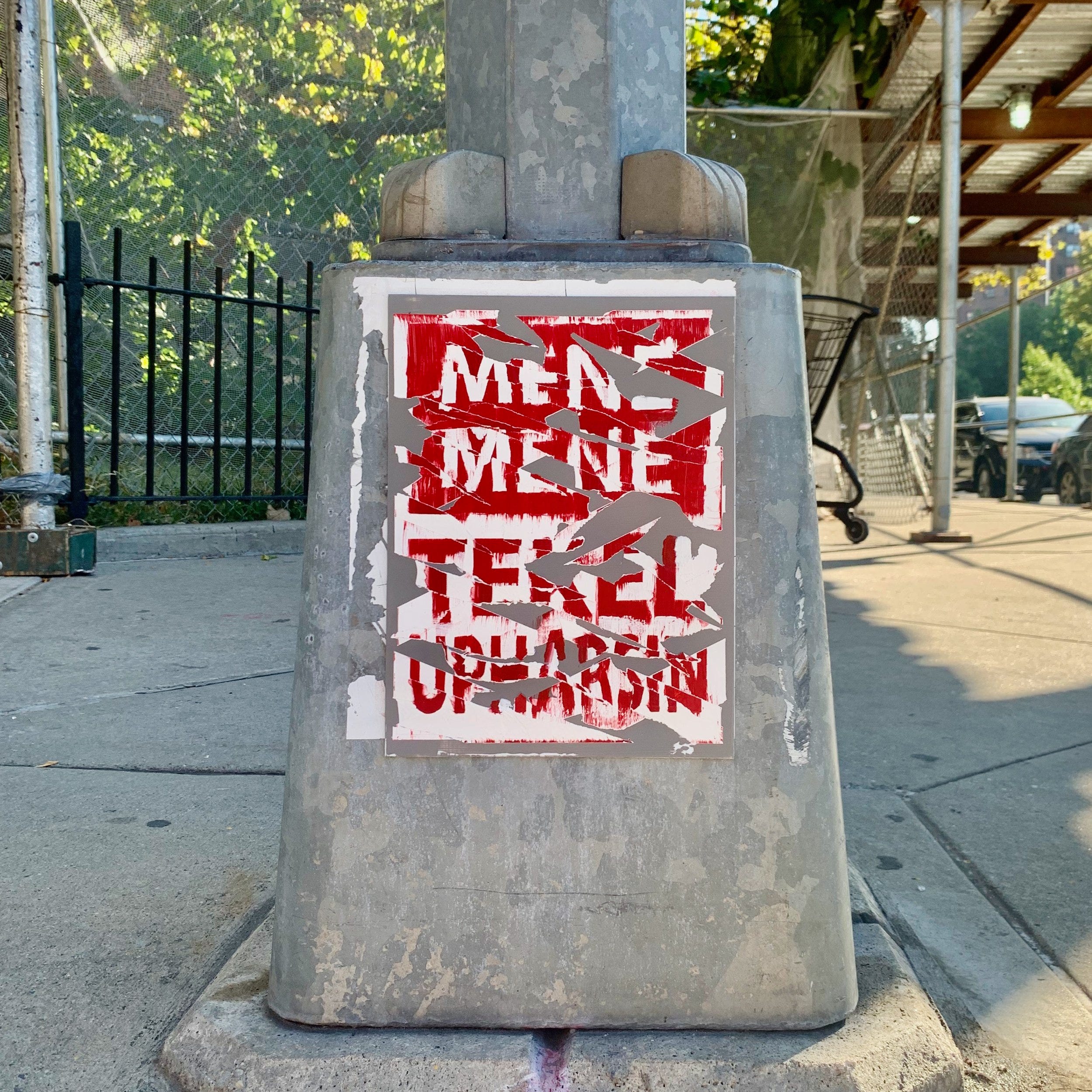
The work is made in the studio, and then displayed outdoors on public infrastructure using a removable adhesive backing, which allows people to take the paintings home with them. The paintings are always free, and are not intended to be an advertisement for something else that is for sale; there is a generosity inherent to the work and its distribution that we hope is contagious. Aesthetic decisions are informed by existing visual information on the ground, and the work is almost always designed with a particular location in mind, so the paintings have a destination that is immediate, near-at-hand, and highly visible. We look for opportunities to use painting to converse with the preexisting urban palimpsest. Layers of stickers, pealing advertisements and paint, hand-drawn graffiti, and haphazard attempts to remove or paint over graffiti are some contexts where the work is particularly at home.
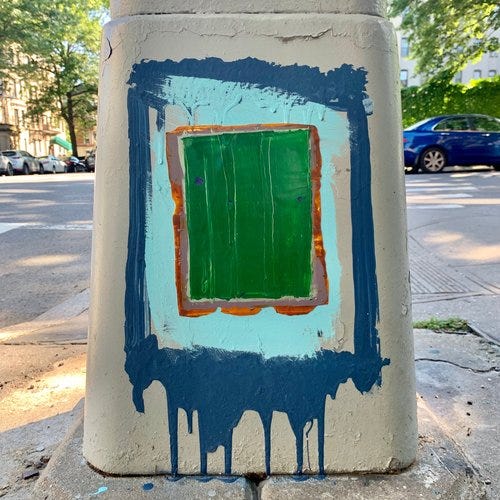
Simply walking around the city is the main component of both the preparation for, and also the eventual display of the work. During our walks we follow meandering paths, talk, look, and install paintings. Thus, the work is a visual record of our somewhat aimless travels in an increasingly instrumentalized and privatized urban environment. And while we regard this project as an open-ended endeavor with no predefined form in mind, we are generally guided by a steadfast desire to challenge the commodification of the art object/form, to assert our autonomy outside of the market, and to resist the very real currents of authoritarianism, coercion and domination running through all aspects of late capitalist society.
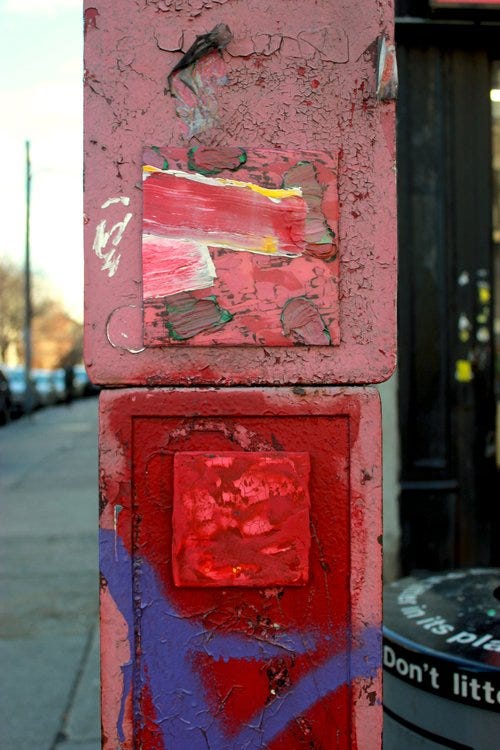
The walk starts when I recognize my friend from across the street, usually near a subway exit/entrance. We smile and greet each other, the day fully upon us. Previous hours have been spent finishing up objects at our disposal, taping and sanding. Only now does the active synthesis begin. Immediately we start to survey the landscape, scanning but focusing on details at the same time. The light, colors and textures of street lamps and their bases. Fire dept call boxes that are in various states of functionality. Their paint is either fresh or flaking, uniform or multihued. Everywhere we look is fair game, walls designated for us, prepped platforms all around, our application has been accepted, the grant has finally come though!
The city is ours and the installed objects, yours. Each object is system specific, not site specific. The palette is influenced by what we have seen over the last few years, but not exactly matched, textures that influence but not completely replicated. The things we hold in our hands are not bourgeois art objects, but not their antithesis either. There is a foot in art history and an arm simultaneously grabbing a street pillar. Then there is the consideration of how these things are to live in the world. Are they to remain up if possible, perhaps “landmarked” by fresh paint applied by a city worker? or are they to be taken down quickly by some basic recognition of aesthetic interest, resulting in an individual possession of this recognition?
As we walk we see commercial possession and private property everywhere. Signs that denote boundaries and people in various states of perception. Our activity goes either unnoticed or is met with confusion. The gaze matters especially in this realm. To install an object is to put it in another world, to transform it from a personal object to a public one. The installer is temporarily at the mercy of the onlookers gaze, back turned and vulnerable. A friend can serve as a buffer to this, as a lookout for enforcers of legality, or to meet the gaze of a curious or perplexed passerby, disarming it by competing with it.
The partner can also give perspective to the aesthetics that arise in each installation, is it level, does it blend too much? Once a passerby intervened as we both discussed the task at hand, “too similar” she said. Point taken. It’s a group project after all and criticism will find its way to us. Another day an observer wondered what we were up to, why were we looking at concrete pillars and electrical boxes? Our suggestion of an art project was met with hostile confusion and requests to do it in our “own neighborhood”. Assuring him that we did in fact do that and that one of us had previously lived close to the area in question did little to convince him, a hostile gaze was projected at us, along with the more impersonal digital lens of documentation.
Speaking of the digital, we use ours to depict the offered objects that are introduced to the landscape. It’s a practice that sits somewhat uneasily. Should we be contributing to the spectacle by adding to a world of shouting images, or is it an acceptable compromise, a justifiable entry point? Rhetorical questions aside, participation with the status quo is of course unavoidable. What is possible as an entry point to a different daily activity? One that can be done despite dominant norms and power structures?
So we walk, for at least a few miles, gathering information and dispersing physical objects, building the momentum of another ethos and talking about all that comes up.
After a few hours, exhaustion creeps in and we stop for food and drink. So much to critique and process, mental notes to make and aesthetic problems/solutions to come up.
Second part next week:
‘Culture’s dialectical nature under modernism has been largely abandoned in whatever we call this contemporary terrain. An aesthetic inquiry could reappear, not as a conservative past reanimated, but activity conceived of as a shared daily pursuit.’